
Abandoning yourself (in-between)
Why we give up in the uncertain space between taking action and seeing the result
Snapshot
Between every action and its result sits a gap with no feedback, no signal, no sense of progress, no timeline. Most self-abandonment doesn't happen at the start or the end of something; it happens here, in that unmarked middle. This piece looks at what that space actually asks of you, and why those who hold their standard through it come out the other side different from the ones who don't.
What words describe the way to lead yourself? These are a few words that I can cluster together that describes how my personal leadership was initially formed:
Run. Avoid. Divert. Distort. Blame. Redirect.
Not by fault, but what unconsciously had been reinforced growing up.
I've observed my dad for many years engage in his experiences but he always ended up disengaging within them. He would either start something and never follow-through (stops acting) or be halfway into something and never sees-it-through (abandons the experience).
When something was asked of him, instead of addressing the call, he would 'run' from it. Either something was out of his control, it was someone else's responsibility or an over exaggeration of his inability because of health related issues.
When I stopped running and confronted the heavier parts of my experiences I noticed a pattern.
The part of every experience that's rarely spoken about… is where everything is decided. Not the beginning, not the end, the part in-between. And more often than not, that’s where we lose ourselves.
It determines who we become, how we behave, how we treat others, also what we do next.
We are most tested in the messy middle, and once you see it, you start to notice it everywhere.
Entering in-between
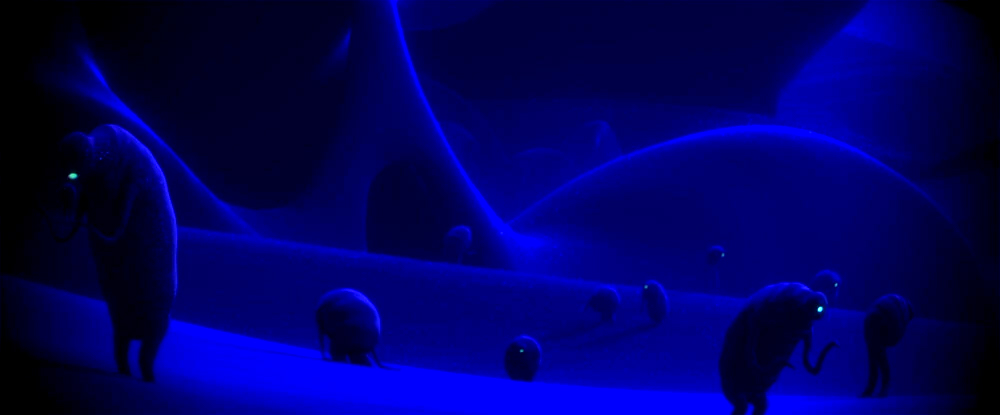
This image is from the Pixar movie Soul. In it, there’s a place where lost souls wander through a dark, endless space. Not because they don’t have direction, but because they’ve become consumed by something. Thought, fear, obsession. They’re stuck in it, drifting, disconnected from themselves and life.
Similar to this space, the in-between is the distance between action and response, a period I call The Void. The moment we initiate or take action toward something, we (unconsciously) enter the void. What's inside the void? Nothingness, just a pause with no feedback. No signal. No indication of progress. No measure of duration.
Here's where you enter the void:
Apply for jobs → void ← Awaiting interview
Onboard client → void ← Paid invoice
Costly mistake → void ← Rectified
Make a presentation → void ← Deliver it
How about areas we don't often notice:
First day education → void ← Last day
Start business → void ← Sell business
In debt → void ← Out of debt
Birth → void ← Death
The void isn’t a period to get through as quickly as possible. It’s a time frame where inner leadership is tested. It's where decisions are shaped, meaning is assigned, behaviour is questioned, and the strength of our standards is upheld.
I’ve often thought about the opposite. What if there was no void? Imagine every action taken creates an immediate result. No need for waiting. No delay. At first, it sounds ideal.
But effort itself would lose its weight. Expectation would take over us. And the significance of doing something we love would disappear. Learning would carry no significance. We'd never endure through because lessons wouldn’t have the space to mature within us.
It's why the void is a perfect frame built for meaning, action-taking, choice, and presence.
Though it's the easiest place to abandon ourselves.
In the in-between
What could we expect externally in between?
Distraction. Challenges. Misdirection. Delay. Criticism.
It's a period during which anything can happen, and it's the very reason your self-leadership is critical. Without it, people can drift in two ways:
1. Insistence - Force what unfolds
Trying to control what occurs, at a rate we'd like it to, in the safest way possible, with minimal effort, without disruption. We have a preference and insist it follows suit.
2. Resistance - Reject what unfolds
Pulling away, avoiding it, or denying. Reject what feels threatening, changes that challenge familiarity, standing to lose something or feeling less in comparison.
Often, we move between both.

When we look around at the world today, so much is happening, suffering, depression, the decline in mental health, harmful behaviour, insecurities, over-consumption, exaggerated lifestyles.
Most of these experiences lead us when we aren't able to practise stillness, composure and discipline. Lack creates desire. Actions take orders from fear. Self-worth requires validation. Attachments create a feeling of loss.
It's in the in-between that I often saw my dad feel less than he was, giving up on what he started, avoiding taking action on what demanded more of him, but also overindulging in everything that had no direct effect on seeing the response.
We often hear the phrase "everyone is going through something we know nothing about" It's true, but what we now know is that they're in the void (in-between). And what we do in the void determines what comes next.
Thrive in-between
What should we expect from ourselves internally, in between? More Self-command.
Shifting our point of reference from what's happening outside to what we anchor on the inside. It’s the difference between someone who needs to check on themselves every time they move and someone who already knows they will show up regardless of what happens.
I used to feel conflicted in the void. That gut feeling we question. Whether we should act on what we know is right or what is commonly done, accepted, or expected.
I’ve tested both.
The weight of doing something I don’t believe is right has always been heavier than doing something others don’t validate. Because in that moment, it’s not confusion; it’s interference. We start looking outwards, adjusting, outsourcing, waiting for someone to tell us what to do next, because we have forgotten where to anchor ourselves.
We have an innate system of guidance that is often overruled by society, culture, family, fears, and even desires. Take, for example, we are already capable of kindness: to give love, to care, to be compassionate, to share and to support one another. These qualities aren’t learned. They’re revealed through experience.
When everything else becomes uncertain, we naturally return to what it means to be human. We don't need someone else to tell us kindness matters. That unnecessary harm isn't the answer. That truth matters. We recognise these things because they don't depend on how we feel or what outcome we're chasing.
What if our actions had that same kind of anchor? Instead of asking, "Will this work?" Ask, "Can I stand behind this action, regardless of what happens next?"
That's the difference between negotiating with outcomes and leading from principles.
I've put this into a practical Self-Leadership Practice/ (SLP) inside the Toolbox. If you'd like to practise it yourself, you can explore it here: "Anchored Action"
The more stable your principles become, the less dependent your actions are on circumstances.
All said and done
Abandonment occurs when we stop practising self-command and instead rely on habits or past experiences to guide our actions today. We fail to make today's decisions conscious and intentional for growth.
Every moment calls our command forward because we are always in between Action and Response. What we do inside it matters most; it's where we fail or succeed in using the resources we possess.
Don't abandon yourself.
Anks Patel
FAQ
Why do I give up right before I see results?
Meaningful progress is rarely visible while it's happening. The gap between effort and outcome usually offers no feedback at all, which is exactly when doubt fills the silence. Giving up here isn't a lack of capability; it's mistaking the absence of proof for the absence of progress.
What does it mean to "abandon yourself"?
It means lowering your own standard the moment a result stops confirming you're on the right track. It shows up as forcing an outcome, giving up early, or quietly adjusting what you believe just to feel less uncertain.
Why is waiting for an outcome so hard?
Waiting combines two of the hardest things to sit with at once: not knowing what's coming, and not being able to do anything to change it. That combination is often harder to tolerate than the outcome itself, whatever it turns out to be.
How do you stay disciplined without proof you're making progress?
By anchoring to what's true and in front of you right now, rather than to a result that hasn't arrived yet. Discipline that depends on feedback breaks the moment feedback stops. Discipline anchored to what you know is right, responsible, and true holds regardless.
Is patience enough to get through, or do I need to take action too?
Patience still frames it as waiting, managing the urge to rush or quit until something changes. Presence is different: it's not enduring the gap; it's staying anchored to what's actually true and in front of you right now, regardless of what hasn't arrived yet. The person who needs patience is still fighting impatience. The person who's present isn't fighting anything, they are resourceful.