
Purpose that doesn’t last
I've questioned the meaning of life more times than I can count. Life struggles often leave us lingering with such a question. And every time I went looking for an answer, externally, I landed on the same word: Purpose.
I know I'm not the only one thinking about what meaning I can give my life. But it’s a term people throw around like it’s self-explanatory. I found that the more I see the world speak about it, the more it's moving away from what it truly means.
Even a simple Google search reveals the problem: Mission statements, personal aspirations, values, goals. Everything but a definitive understanding of purpose.
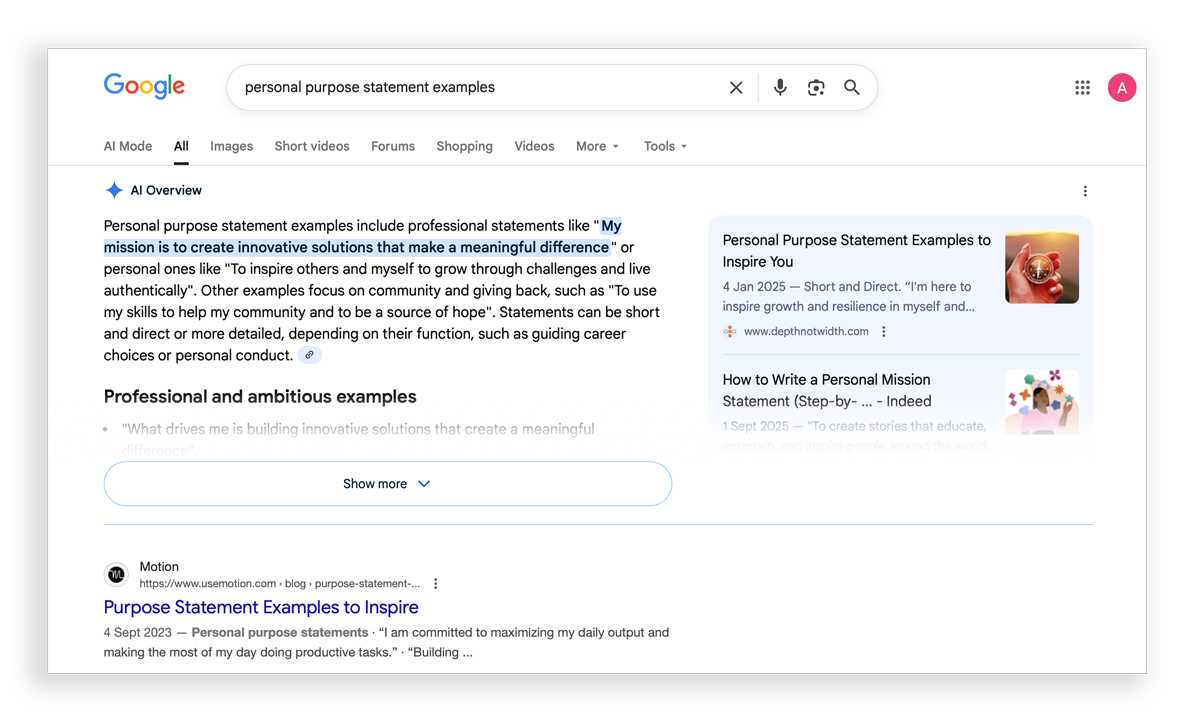
I used these statements too, in my earlier years in brand strategy while helping clients. Every version felt good in the moment and on paper, but none of them stuck. For me, I'd sit with it, repeat it, refine it, but something felt missing. I couldn’t help but think, this isn’t it. The search didn't end, it got louder inside.
When purpose is borrowed or built on a shallow understanding, it never takes root in you. People scroll, consume, and copy, hoping meaning will arrive. But some things can’t be borrowed. They must be developed. You can...
borrow a statement, a framework.
borrow actions and behaviours.
borrow how it feels.
But you cannot borrow the evidence that makes it real.
Purpose is not a sentence we write. It’s a pattern that's lived long enough to recognise. That's the difference between a purpose statement and the origins: one sounds good, the other has receipts.
Many believe they've found their purpose because they articulate a compelling why. It's meaningful, it feels right, it's catchy, and it reflects what is true now. I, too, bought the books, the courses, the frameworks, all helpful, but they send you down a path shaped by someone else's lens, not our own.
Most can answer 'what is my purpose', but a few can explain:
→ Where is came from?
→ What formed it?
→ When does it show up?
→ How do they know it's true?
That's the real work.
Purpose becomes preference
I circled many assumptions about purpose and, in doing so, dismantled what's been adding to the confusion. Most people never reach purpose because they stop at 'why'.
A why is a reasoning. Sounds meaningful. It's admirable and inspiring, something we can stand behind. It gives the ego something noble to hold. But life shifts, pressure rises, results get messy, circumstances change, the ‘why’ quietly disappears, drifts to the side until things feel ideal again.
Your 'Why' is easy to hold when life is comfortable. Which is why these two patterns keep people stuck, often without realising it:
Feel-Good Purpose
Formed by what sounds inspiring and affirms one’s identity. When purpose feels good, it’s usually built on reasoning, not responsibility.
And when I say responsibility, I don’t mean “we got more to do.” I mean the action we take, regardless of whether it's the right time.
It’s life asking you: will you rise or retreat?
Over and over again.
Conditional Purpose
IIs when purpose only feels true when life is calm, controlled and convenient. When it depends on your circumstances, it’s a preference. Here are two examples:
1. My purpose is to be a leader to my team, live a balanced life and make a difference
2. My purpose is to continually grow and improve by learning new skills
They are built on good intentions and strong values.
They aren't uniquely specific; we'd all share the same sentiment.
They rest on a silent, unspoken condition.
They’re put on hold when:
→ Safety or predictability is removed
→ Results are unexpected, slow or unclear
→ Inspiration fades, and it becomes demanding
When I struggled to put food on the table or pay off debts, purpose was the last thing on my mind, and that didn’t stop any challenges from coming.
Those feel-good and conditional statements didn’t hold up. They collapsed when life got tough. When we make purpose fit life when it’s comfortable, it’s dressing self-significance as direction. Because the real purpose doesn’t disappear when life gets hard, it becomes louder.
It arrives through responsibility, not inspiration. It calls on us in moments that are rarely convenient or favourable, in big and small ways.
When these moments are avoided rather than met, life starts to feel shallow because we didn’t rise to the challenge.
Assumption to dismantle
Like most concepts today, they are partly understood and packaged for sale. We then partially adopt them, only to find ourselves ill-informed or searching for missing data. We can always use our trusty Wheelbarrow Test to better understand a term. We can't place it in the barrow, so it is a term that encompasses more than one process (in our case, more than one occurrence or experience).
I’ve learned to question the depth behind ideas before accepting them as truth. No matter where it comes from or who says it, discernment matters. Here are five assumptions that kept me in purpose-search mode for many years.
1. Purpose is a fixed
I followed the norm: searching for the correct statement, hoping it would “click”. Looking for the line that would make life feel complete.
But the real trap is treating purpose as a fixed answer.
→ My purpose is to inspire
→ My purpose is to help people
→ My purpose is to be the best version of myself
All worthy directions. But they are not the purpose itself; they are positive reinforcements. The word 'is' binds the answer into a “this = that” structure: Purpose = that. If inspiration, helping, or your best self is absent in this example, purpose feels absent, too.
[No Inspiration] != Purpose
[Not the right time] != Purpose
[Not feeling my best today] != Purpose
Purpose is dynamic, not static. Learning to recognise what make it's it so is critical.
2. It's who I am
My first grasp of purpose felt like a crown, something to wear, sounded noble and felt good. But it didn’t ground me. It inflated me.
I often hear a similar tone: “My purpose is to inspire change in people.” The intention is real, but there’s a subtle trap; it speaks to who we are (Our identity).
Being someone who can inspire feels aspirational. Living the responsibility, especially in uncomfortable or inconvenient moments, does not. Purpose rarely arrives when conditions are ideal. It also shows up in quiet conversations, difficult decisions, small obligations and unseen moments.
Even when we’re not ready for it, it calls.
Awareness of that call is what matters.
3. Starting with passion
I often hear the question, “What are you passionate about?” It invites pleasant emotions, excitement, energy, and joy. It's a starting point, sure. There’s nothing wrong with passion. But passion translates into feelings, and feelings change. quickly in high-pressure moments or subtly in small doses over time.
When the search becomes about what feels good or interesting, we drift away from what we’re actually here to uphold.
Passion lifts us.
Purpose anchors us.
When passion fades, people don’t just feel less excited; they feel lost. Mistaking energy for direction. A newly found passion doesn’t mean a new purpose. It’s simply a new expression.
The spark may create momentum.
But when it fades, purpose is the part that remains.
4. My circumstances
In a workshop, I asked participants what they believed their purpose was. Common answers are as expected: “to be a father” or “to be there for my family.” Meaningful roles, but they are only channels through which we take action.
If purpose only exists based on circumstance, what happens when that circumstance changes? And it will. A purpose that depends on conditions becomes a momentary phase, a season of life.
What remains true is this.
When purpose shows up, it calls us to act.
Often in a different form than before.
5. More than one purpose
In business, niching down creates clarity. Purpose works the same way.
Not: “My purpose is to do this for this person.”
More like: “I know what summons me.”
When we try to pursue multiple purposes at once, we end up with noise. Instead of decluttering our awareness, people spread themselves thin on a variety of things. It's the mentality of 'throw it on the wall to see what sticks'. Nothing wrong with it, but it's a behaviour when we don't know what we're anticipating.
Some people are honest enough to admit it.

A better (proven) starting point
I’ve come to see purpose like a switch. Switching ON when our awareness meets responsibility. It happens when you become aware of a ‘consistent challenge’ that calls you to act, every time. In different forms, in different environments, but the same underlying call.
Think of the challenge as a sprinkling of tension throughout our lives. And unfortunately, it doesn’t come with an obvious signal or a name called "purpose"; we’re left to piece that together.
For each of us, it's something different:
For some, Conflict
Someone is being pushed to speak the truth.
For some, Self-worth
Someone is being reminded to stop shrinking.
For some, Discipline
Someone is being exposed to what they keep avoiding.
That repeating tension isn’t random. It’s not life being cruel.
It’s life showing us what you’re here to confront.
Acknowledging the nature of our challenges is a scarce understanding today. It’s not taught. It separates those who chase meaning without knowing what to chase from those quietly rooted in it.
The tension in our experiences is hidden in plain sight. The task is to reflect and find the core thread connecting them all. When exploring our experiences, pay attention to the pattern repeating itself. Perhaps to start, you might want to journal about them, question their meaning, re-question your answers, and categorise what seems obvious and familiar.
Exploring purpose takes awareness, so pause and reflect; it takes a shift in perspective, so dismantle what you cannot attest to. Don’t make it up, without the personal realisation, it’s a guessing game.
This is work we’ve done with people like Pritesh, Theo, Prince, myself and many others.
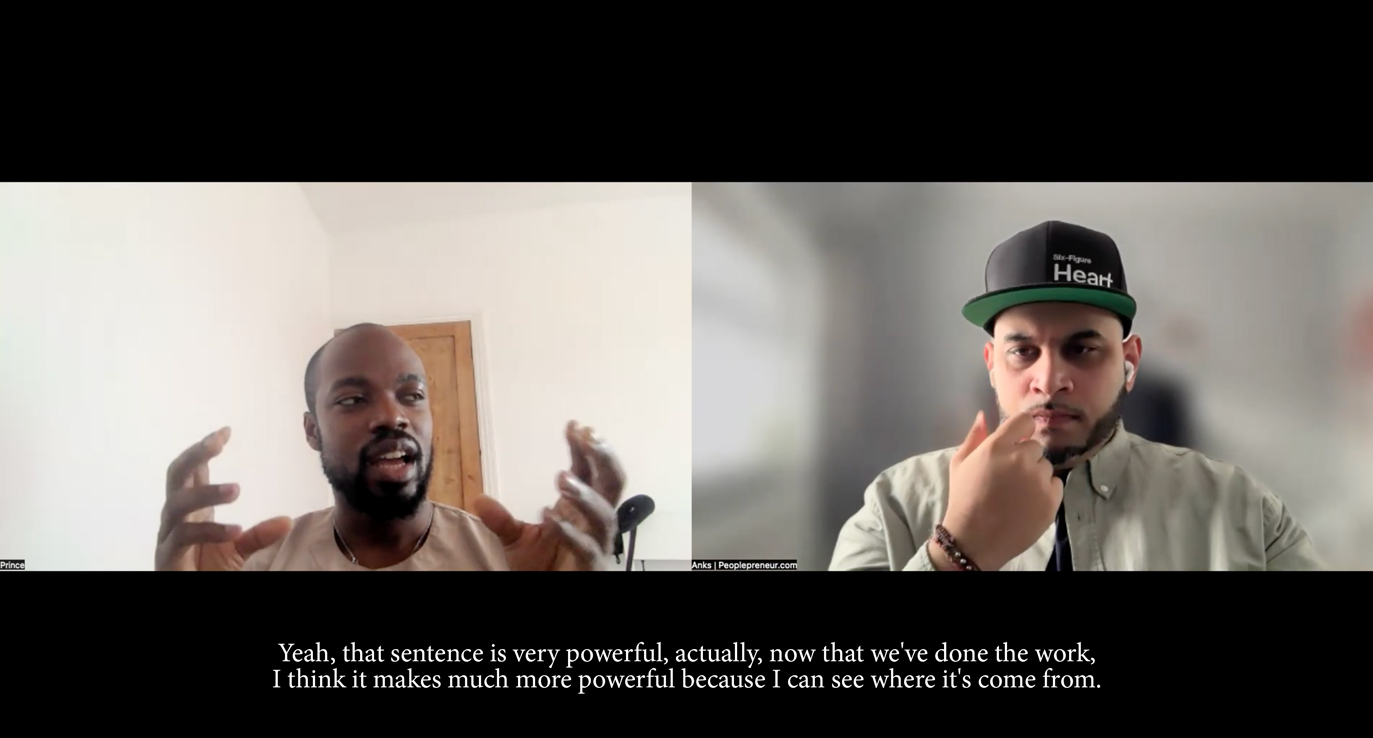
For a purpose to exist, awareness and action are needed. The awareness of what is calling us and then the action to overcome it. Like this:
[Become] Challenge Aware + [Take] Intentional Action = [Live]Purposefully
Purpose isn’t discovered. It’s proven through repeated responses. Otherwise, fluffy statements remain justification, nothing more.
All said and done
Stop asking ‘What is my purpose.'
There is no sigle answer that defines what it really is.
Begin noticing the patterns in your past and present that have kept showing up in your life: the good, bad and the ugly. Categories them and draw a conclusion of what the challenge looks like. Overcoming that brings us purpose and the feeling of meaning.
When that level of clarity exists, meaning follows, so does accountability.