
Why being yourself feels like effort
I was having fun with my little one in a retail shop and couldn’t resist the narrative our culture encourages.
It reminded me of when I was catching up with a fellow business builder I hadn’t spoken to in years. The same adopted understanding presented itself. The conversation was natural, open and effortless. Midway, they justify the catch-up, “I’m reaching out to connect with like-minded people who want to authentically make a difference”.
Authentically?
What began authentically stopped the moment that word was used. The word felt out of place. It didn’t feel real; it felt persuasive, almost scripted. Like an attempt to build rapport. To make me feel that I was being seen as 'authentic', while simultaneously signalling that they were, too. This revealed a threefold problem. People are:
1. Trying to be authentic
2. Be seen as authentic
3. To perceive authentic
All of which is creating confusion, mistrust and misreading. Because it's strange to think we can perceive authenticity in someone else.
What we call “authenticity” is merely our interpretation, shaped by our expectations, beliefs, culture, and our filtered meaning. We cannot directly and objectively observe their authenticity; that's impossible.
The world’s obsession with appearing authentic sends people in the opposite direction, leading them off track and trying to measure themselves by someone else's interpretation.
Measuring by their meaning
At any time the word authentic is introduced, there is a metric, a silent expectation set for us to align to, an internal standard that is unaware. The moment I heard that in that conversation, I realised I wasn't being understood or accepted; I was being measured against a standard I didn’t even know.
What's bad about it?
1. We feel that we need to be seen.
2. We silently adopt what validated us.
3. Our behaviour begins to protect it.
The feeling of being authentic from someone else's perspective is like a drug; once is not enough. We want that feeling again, so we search for more, and when it doesn't come, we start to perform authenticity. Adjusting, tweaking, softening, or emphasising parts of ourselves to match their idea of what's “real”.
Unconscious Measurement
I came across a social post encouraging people to “show up as yourself.” I smiled, because even if I was, how would they know I did or didn't? Anyways, they followed it with a list of ways that person was doing it, they said:
→ Dress for yourself
→ Own your imperfections
→ Stop apologising
These are good practices, and it sounds empowering, but look closely. It’s built on a narrative. It's a reaction to a set standard built by what others think. This is what measuring ourselves on their meaning looks like. Let me show you why.
To, dress for yourself, if it needs to be declared, justified or framed, it's still about declaring your choice. At some point, we'd say, "I dress the way I want." Is this truly dressing freely? Why does it need to be said? It's still a reaction to an expectation. Why not simply dress without explanation?
To, own your imperfections, is to call out a label named imperfection. It keeps the standard alive. The measure is still reacting against what is considered a flaw; we're still playing in the field of imperfection. Why not simply accept that being human requires no label?
To, stop apologising, you only do so in a world where you expect disapproval. The behaviour is still shaped by 'disapproval'. It's a reaction to judgment, just in the opposite direction.
Each point is built around the same reference point: an interpretation set by someone else. Our behaviour towards it just looks independent, but it's not. Authenticity is being played the same way.
Unconscious agreement
This type of behaviour is characterised by a pattern called Symmetrical Relations, a fancy name for how we mirror meaning. A simple way to see this, I say I'm your friend, then by implication, you are also mine, by symmetry. What if I said I'm your brother, are you mine? Not necessarily, you might be my sister, that's the opposite, Asymmetric Relations.
Authenticity is being used in the same patterning. You act in symmetry to it by matching it, making it real and true.
Example 1:
They say, "You're too sensitive"
Response: "I just take things personally sometimes"
Symmetry - You've agreed that Sensitivity = Weakness.
Example 2:
They say, "You should be further along by now"
Response: You begin to list everything you’ve been doing
Symmetry - You’ve accepted their timeline as the standard.
Example 3: My business conversation above...
They said, "...people who authentically make a difference."
Response: We begin to emphasise values, purpose, and impact
Symmetry - You also now believe people don't truly make a difference.
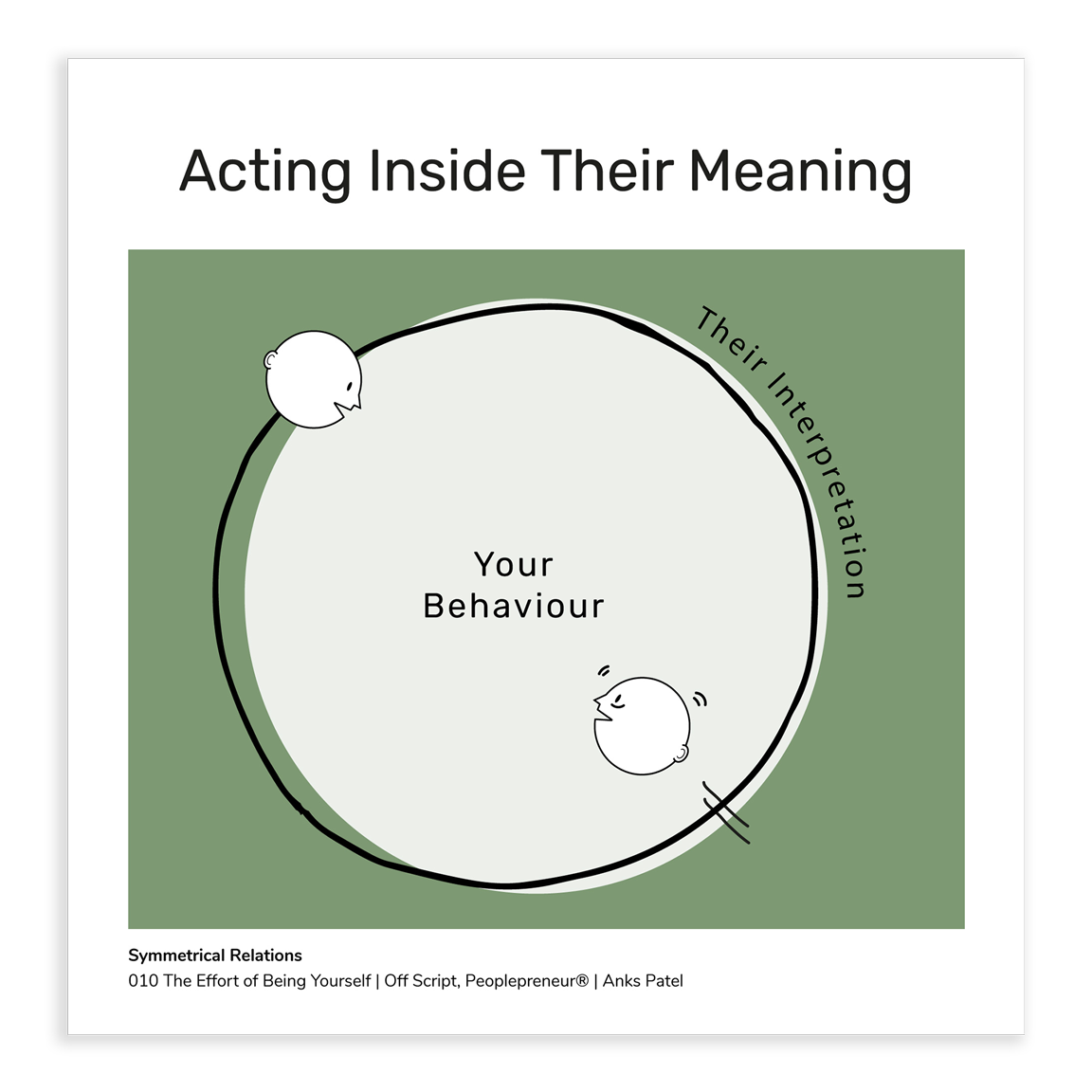
The moment you begin to react, you’ve already accepted their meaning as the reference point. You are within their frame, validating their interpretations. Authenticity today follows this pattern of matching, and we don't realise it as we participate in the same relations.
Hold yourself to yourself
When we treat authenticity as something to show, a behaviour, an image, a signal for others to recognise. In the personal brand arena, it's an overexpression of individuality, often stemming from personal gain. But authenticity is a state of being, held in different contexts, more importantly, independent of external influence.
A friend of mine, Mandeep Singh, comes to mind.
I met him in my first year of university. He held himself differently from others. He walked beside me through my struggles with homelessness for years. He gave support when I needed it, provided space in his home when I had nowhere to store my belongings, and drove me back and forth when I couldn't afford the bus. He embodied optimism, and I absorbed all of it.
After almost 20 years, today, he is exactly who I met on the first day. He is the same in front of me, my family, at his work, in education, with his wife, at home, everywhere. If life throws a curveball at him, he responds the same, intentional and calm. He holds a state that favours him.
I can call upon him today, and regardless of any outer changes, his core comes through. I know it to be true because I've observed and felt it consistently many times.
It’s easy to mimic what someone does or what they think works. That's what much of personal branding today sells: established approaches, familiar styles, polished lives, everyone projecting the same signals.
But the state itself cannot be copied. That’s a personal practice. I can copy Mandeep, but I would never be him. If there was anything I’d emulate from him, it's this: hold yourself to yourself.
When people try to show, speak, or encourage authenticity, they enter what I call the Authenticity Paradox. It's our adoption of authenticity that contradicts the behaviour required to live it.
To be Authentic → Stop performing it
To prove Authentic → Start performing it
We cannot truly be and show at the same time. The moment authenticity becomes something to demonstrate, it turns into a performance. It's what I call ill-informed authenticity: a distorted version of individuality in which people aren't expressing themselves, they're circulating approval.
He was only human
When the advice given is “be yourself” or “be who you are”, it’s encouragement for alignment, but not authenticity, because phrases like that assume people know who they are first, and most:
→ Don't know how they are
→ Haven't defined the values that they embody
→ Don't act from alignment
→ Aren't leaning on their own judgment
→ Don't respond from truth but pressure or fear
For most, this work is untouched or incomplete. So adopting 'be yourself' gets aligned with an unexamined identity rooted in past experiences, wounds, expectations, or survival.
I realised in this one moment that authenticity wasn't behaviour-related.
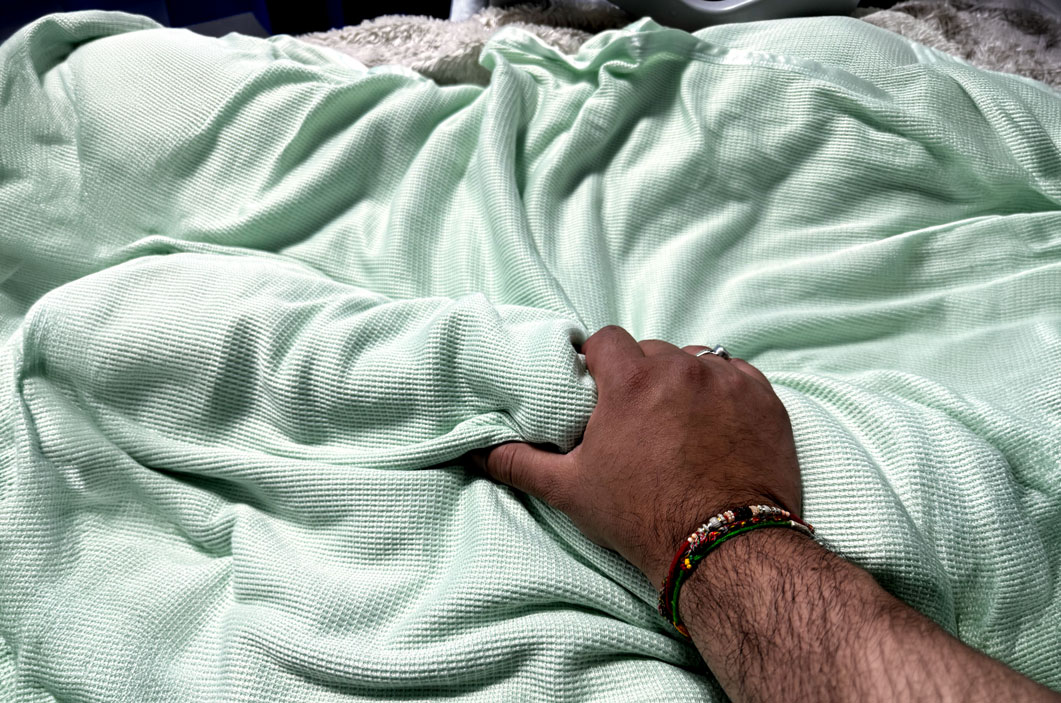
When my dad was declared to have 24 hours left to live, he endured a further 87 hours with breathing issues, struggling and drowning inside his own lungs. During hour 80, I was alone with him in the room, and he mumbled something. I leaned in.
“Thank you.”
“For what, Dad? You don’t need to say thank you.”
He whispered, “For being there for me when I needed you the most”.
In that moment, years of frustration washed off me.
- His stubbornness wasn't his identity
- His demands weren't his identity
- His emotional weight wasn't his identity
- His avoidance wasn't his identity
All the parts of him that were difficult and unhealed were his coping patterns. It hit me like a force I wasn’t prepared for: He was only human. He was trying, just like the rest of us.
I was already patient, willing, and understanding of his ways, but something that day emerged in me: forgiveness, clarity, and truth.
→ People are trying, despite their lies and masks
→ People are surviving, despite their burdens
→ People are reacting, despite their intentions
→ People are carrying pain we never see
Authenticity isn’t built on polished identities; it’s built on being human.
Everyone is trying, we are all practising the art of being human. Seeing that in others removes the pressure for anyone to be anything more, and it allows all of us to harness our personal power.
All said and done
Authenticity is humanity expressed from a natural centre.
Living from your core inner state, everywhere, is what makes someone truly genuine, real and unquestionable. Dropping the need for the term authenticity entirely is the most liberating thing we can do for ourselves and others.
By our very existence as humans, we are authentic. If we or anyone requires anything more, we start changing ourselves.
Oh, and my business conversation earlier, it seems they weren't embodying this insight. I haven’t heard from them since! I don't think I'm authentic enough for them anymore, because I didn't serve their agenda 😏.
Until next time, self-leaders.
Anks Patel