
The Ego Hiding in Modern Gratitude
Why comparison-based gratitude doesn't last, and the three stages that make it stick.
Snapshot
Gratitude has three stages: Recognition ("I see it"), Embodiment ("I live it"), and Stewardship ("I extend it"). Most gratitude practice, including the popular social posts you've probably seen online, stops at recognition, encouraging you to become aware of what outcomes you feel grateful for. Often it's built on comparison, someone else's hardship to generate a quick sense of relief. That's exactly the stage where the ego moves in, and where this piece picks up.
Gratitude is one of the most recommended practices in personal growth. Yet for something so widely practised, why does it feel so short-lived? Perhaps it's because we've mistaken relief for gratitude.
I've come to accept that much of what the world shares is well-intentioned, but incomplete. And when incomplete, it makes the practise also incomplete.
Much of our time is spent endlessly scrolling social media, and without an internal filter to process what we're consuming, we can harmfully accept everything at face value.
The other day, a post caught my eye, from someone I admire at a distance. It was about gratitude, but this one hit different. At first it felt like gratitude. Looking closer, the mechanism isn't appreciation, it's comparison. Study the post:
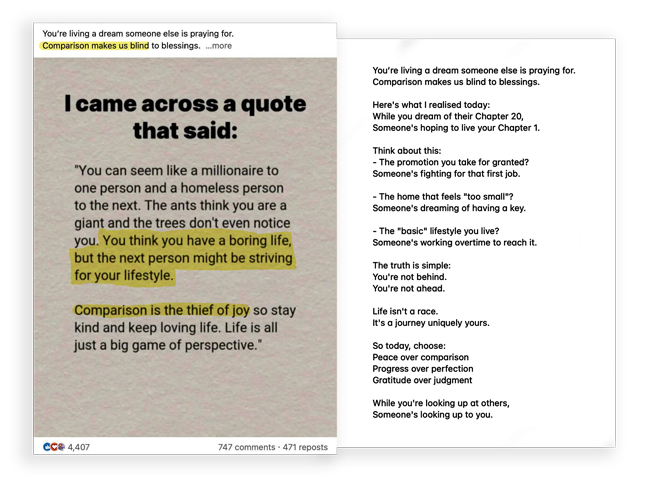
The post itself is a repost, not an original, but I've highlighted a contradiction. It asks us to feel grateful, but in what context? Because someone else has less. Ironically, the idea you've heard a thousand times, that "comparison is the thief of joy," is the very mechanism being used here to generate relief.
Aren't we all living our own particular chapter, fighting for a career, building something, dreaming of what comes next? Suggesting we allow ourselves to feel relief by quietly comparing our lives to those who have less, that isn't how I choose to operate. Is it how you want to?
The truth is, humans rarely recognise abundance while they're in it. More often, we need contrast to see it. Loss reveals value. Scarcity reveals abundance. Absence reveals appreciation. There's something deeply human about this. Avoidable? Sure. Surprisingly true? Also yes.
Modern gratitude usually begins with the question, "what can I be grateful for?" That question invites comparison, because now we're thinking on the level of have/haven't, is/isn't, mine/not-mine. It's why this post encourages us to avoid comparison, yet does so unintentionally, just in the opposite direction. It's still comparing. It has only changed which way it points, reinforcing the very thing it claims to overcome.
What if much of modern gratitude isn't gratitude at all? What if it's self-soothing, dressed up as wisdom?
Perhaps gratitude is more than acknowledging what we have. Perhaps that's only its first phase. Real gratitude may have layers, three, to be exact. Understanding them may move us from temporary relief to something far deeper: gratitude that serves something beyond ourselves.
The gratitude journey
The post above isn't wrong. It actually points to one aspect of gratitude, one expression of a much bigger understanding.
It largely operates within the first layer, the ability to notice what is abundant in our lives, often through comparison, contrast, or lived experience. After all, our appreciation matures this way: health through illness, time through regret, relationships through loss.
But if gratitude begins and ends at the first layer, it quietly becomes fertile ground for the ego:
- The ego inflating identity - "Look what I have."
- The ego inflating position - "At least I'm not there."
- The ego inflating possession - "This is mine."
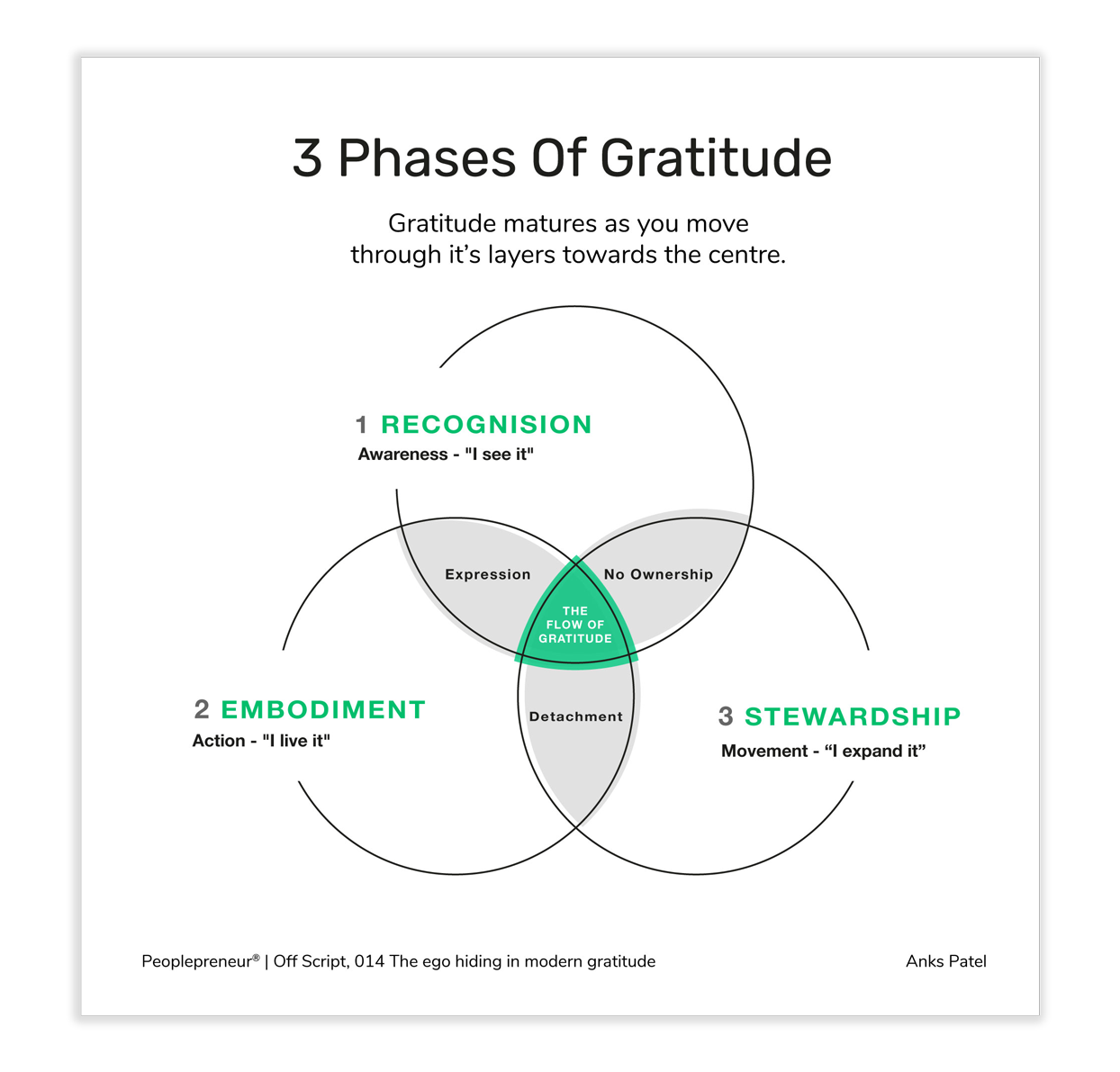
I've come to realise gratitude also matures our relationship with the ego. It does this through three phases:
- Recognition — "I see it."
- Embodiment — "I live it."
- Stewardship — "I extend it."
Perhaps true gratitude isn't found in any one layer alone, but in the journey toward the centre.
Recognising what enables gratitude
Recognition is where gratitude begins. It's the practice of slowing down long enough to notice what is already abundant and flowing through our lives: time, health, relationships, opportunities, support.
The question we usually ask ourselves is, "what am I grateful for?" It's a question that forces us to think in outcomes, in end results. But gratitude deepens when we recognise the conditions that make those outcomes possible in the first place. Instead of saying "I'm grateful for my health," find what makes it possible. "I recognise..."
- that I have the time to prioritise my wellbeing.
- that I have access to nutritious food.
- that I have the support to make healthier choices.
The clarity here matters, because the ego prefers outcomes. It seeks to inflate identity. Quietly it asks, "what does having what I have say about me?" Or worse, "where does this place me, above or below?"
When we need outcomes to feel grateful, we risk feeding the ego. Comparison, like the one in the post above, becomes one of its favourite tools. Our gratitude quietly shifts from appreciation to significance.
Becoming aware of what enables us to do, be, and have what we set out to achieve - that's where the abundance actually is. Yet recognition that stays only in thought is incomplete if it never shapes our behaviour. We have to express it.
Embodying what is abundant
Embodiment is where gratitude moves beyond thought and into behaviour. Gratitude isn't only something we acknowledge, it's something we honour through how we choose to live.
Take the example of health from earlier, and see how embodiment anchors our agency once we've learned to live it out:
- time for wellbeing → "I create space in my schedule to stay physically healthy."
- access to food → "I choose foods that nourish me over foods that are just convenient."
- support for choices → "I nurture relationships that invest in me, and I invest back."
Aligning our actions with what we claim to value is how gratitude manifests. Aligned action takes shape through integration, not performance. Otherwise, the ego sits alongside the value, using it to position us against others.
Quietly it asks, "Where am I in relation to others?" And before long, what began as gratitude becomes judgement rather than stewardship:
- "You should know better," instead of "Could there be a better way?"
- "People have no discipline," instead of "Sticking with it helped me, try it."
- "Don't eat that, you'll get fat," instead of "Do you think that will nourish your body?"
The danger isn't action; it's turning action into status. The moment our choices become a ladder for comparison, gratitude turns into hierarchy. Embodiment moves us from awareness to action, yet gratitude, which benefits us, remains incomplete. It remains naive.
Which brings us to an important question: can I detach from what I believe is mine?
Stewarding what moves through you
If recognition helps us see the abundance that flows to us, and embodiment helps us honour it through action, stewardship asks a harder question: what do I do with what has been entrusted to me? It carries responsibility. But be careful here.
It's easy to mistake stewardship for leverage. How do I scale this? How do I monetise this? How do I create more from what I already have? Those questions can quietly pull us back into scarcity, into the feeling of not enough. There may be a place for them eventually, but stewardship begins somewhere else entirely.
It begins with, how can I move this through me?
Take a look at how the earlier examples can be stewarded:
- time for wellbeing → space for health → invite someone to join you on a walk.
- access to food → nourished body → offer food to someone in need.
- support for choices → nurtured relationships → make space for someone else.
Stewardship lets abundance keep flowing through us, because the moment gratitude becomes solely about extracting more, the ego quietly re-enters the room to possess it. We start to feel entitled. This is mine. My knowledge. My success. My wealth. My influence. My opportunity.
I remember struggling with a lack of food in my earlier years. Today, I have options. One practice I've adopted is simple: when I buy a coffee, I often buy a second and ask the server to gift it to whoever they choose. Not because it changes the world, but because abundance moves differently when it isn't held too tightly.
The steward understands that gratitude isn't measured by what we keep, but by what we do with what we've been given. We move from ownership to stewardship. From holding to sharing. From accumulation to circulation.
The abundance no longer stops with us. It moves through us.
All said and done
Perhaps gratitude feels shallow because we stop too soon. We recognise what is abundant but never let it shape how we live. Or we embody it, but never let it move beyond ourselves.
The maturing of gratitude decentralises the ego:
- Recognition - abundance flows to us.
- Embodiment - abundance is honoured within us.
- Stewardship - abundance moves through us.
Perhaps gratitude feels shallow only when it's never allowed to mature.
The lesson here isn't learning how to be grateful. It's learning how to relate differently to what we've been given. Because gratitude isn't measured by what we have, or even by what we do. It's measured by what continues, because we were willing to let it move through us.
Anks Patel
FAQ
What is toxic gratitude?
Toxic gratitude is when appreciation is used to avoid an honest feeling rather than to reflect one, most often by comparing your situation to someone worse off ("at least you're not there") until the discomfort quietens. It looks like gratitude from the outside, but the mechanism underneath is comparison, not appreciation, which is why the relief it produces rarely lasts.
Why does gratitude feel fake or forced sometimes?
It often feels forced when it's asked to do the work of recognition alone, answering "what am I grateful for" without ever moving into how that gratitude is lived out or extended. Recognition is only the first of three stages; gratitude that stops there tends to feel more like self-soothing than genuine appreciation.
Is "comparison is the thief of joy" actually true?
Comparison can be a doorway into gratitude, since loss, scarcity, and contrast often reveal abundance we'd otherwise overlook. The problem isn't comparison itself; it's when that comparison quietly becomes the only mechanism for feeling grateful, which keeps gratitude tied to someone else's hardship rather than your own recognition, action, and extension.
Why does gratitude journaling stop working over time?
Gratitude practices tend to fade when they stay purely mental, repeating the same acknowledgements without ever shaping behaviour. Gratitude that moves into embodiment, actually living out what you recognise, and stewardship, extending it to someone else, tends to hold up better than recognition alone.
What are the stages of gratitude?
Three: recognition ("I see it"), the awareness of what's already abundant; embodiment ("I live it"), aligning your actions with that awareness; and stewardship ("I extend it"), passing what you've recognised and embodied on to someone else. Gratitude matures as it moves through all three, rather than stopping at the first.