
When effort doesn’t feel like progress
While decluttering the other day, I found old payment slips that I had made to the bank years ago. Ten pounds, deposited and distributed, ten ways. Every month, I allocated £1 each to 10 debtors through a mediator.
It wasn't much, but it was a system that grounded me when nothing felt secure. Those slips reminded me of the deeper work I was practising back then: Learning to manage with the discomfort.
You can do everything right. Have a plan and execute consistently. And still feel like you’re stuck in the fog. That's the part nobody prepares you for, I call it The Void: the period of uncertainty before anything changes. (I'll leave that for another newsletter)
The reality we all face is that not everything works the way we want it to. We can't see around the corner. We don't know what the results might be. We're unsure if we'd pass the test. We fear the worst might be true; we'd stay stuck. I'm sure there are plenty more scenarios, but when uncertainty lingers too long, most of us reach for comfort to mask the discomfort:
- Encouraging phrases: "Stay consistent, it'll work out"
- Common advice, "Be patient and put the reps in"
- Belief systems: "Good things take time"
These sound harmless, encouraging, even. But they don't remove uncertainty. They just give us something to hold while we avoid facing it. And that avoidance slowly weakens our inner leadership.
The complete kit assumption
When uncertainty strikes, the nearest reassurances are often within reach. Even if it doesn't last, it's better to have something rather than nothing. This is False Certainty: something that makes you feel safe without actually increasing your ability to handle uncertainty.
And the world has plenty of it offer us.
I've done this more times than I can count. I've scrolled, searched and subscribed to anything that promised stability: a hack, a routine or a formula. Yet, the more I relied on these external anchors, the more I drifted from my inner authority. The ability to reference, evaluate, and direct ourselves without needing outside input.
The constant search for answers has wasted time, energy, and money. Spiralling us at times in an emotional battle with ourselves. Impulse buying into programs or subscriptions, thinking someone else's blueprint would have everything I need. As much as the material was useful, it was contextual, designed for specific situations, not my reality.
The complete kit is a belief that somewhere outside of you is a system that will remove uncertainty. A method to make experiences easier, faster and safer. But all it really does is shift your attention away from the real work.
The world sells certainty in a simple package:
1. Follow exactly what they did
2. The outcome is guaranteed
The second one is a promise where the illusion lives. What's missing from the package is what happens when life intervenes. When money tightens, plans break, or progress stalls. There is no guarantees for those moments. Yet we keep acting like there is. You might have experienced some of them already:
When you're struggling → Trust the process
When they're succeeding → They know something you don't
When you're unknown → You're not credible
When they're recognised → They are worth following
I no longer entertain these types of encouragement. They aren't absolute truths. They're shortcuts, explanations we adopt so we don't have to sit with uncertainty. These aren't antidotes to the problem, they're pacifiers.
The only complete system is you.
Your inner ability to evaluate, adapt, decide, and respond. No one outside of you holds the answer, and every time we believe they do, we pay the cost.
The quiet (eroding) price of comfort
Over the years, I've learnt to be okay with being wrong. Mistakes no longer sting like they used to. I adjust and move, and don't linger.
I realised the danger is not that we get things wrong.
↳ It’s that we neglect our command by trying so hard to get it right.
We do this every time we buy into a form of certainty outside of us. It could be frameworks, formulas, or feel-good philosophies. We hand over our authority.
We're not managing the environment, we're managing ourselves through it.
What follows is costly:
Our identity becomes tied to systems
If the system works → Credit the framework
If the system fails, → You become the problem
We lose trust in our own instincts
The system fails → We struggle and seek a fail-safe.
Find any strategy to guide us out, no matter the cost.
We become obsessed with outcomes
The system glorifies results → We attach our worth to it.
When results don’t come consistently, we begin to see ourselves as failing.
And the real cost of comfort:
We only feel safe when something outside of us offers a guarantee.
So we keep searching not for growth, but for reassurance because we don’t yet trust ourselves to lead through uncertainty.
False certainty becomes a form of compensation for an inner authority we don’t yet trust.
The answer is presence, but not the kind the world talks about, the kind that holds steady without guarantees.
The only guarantee
Just recently, I was hit with an unexpected debt, and of course, it's never at a convenient time.
When you move past the initial thoughts of why me? Why now? What did I do wrong? The noise settles, and something becomes clear: you still have to lead.
Uncertainty doesn't pause our responsibilities, unnecessary pressure doesn't remove the need to decide and waiting for things to be secure doesn't change what needs to be done. So being able to hold space, composure and calmness right at the beginning of such moments is critical.
The practise of presence matters. Not the kind people share about being aware, emotional processing, slowing down, or quieting the inner noise. Presence is about merging our inner resources with our outer reality.
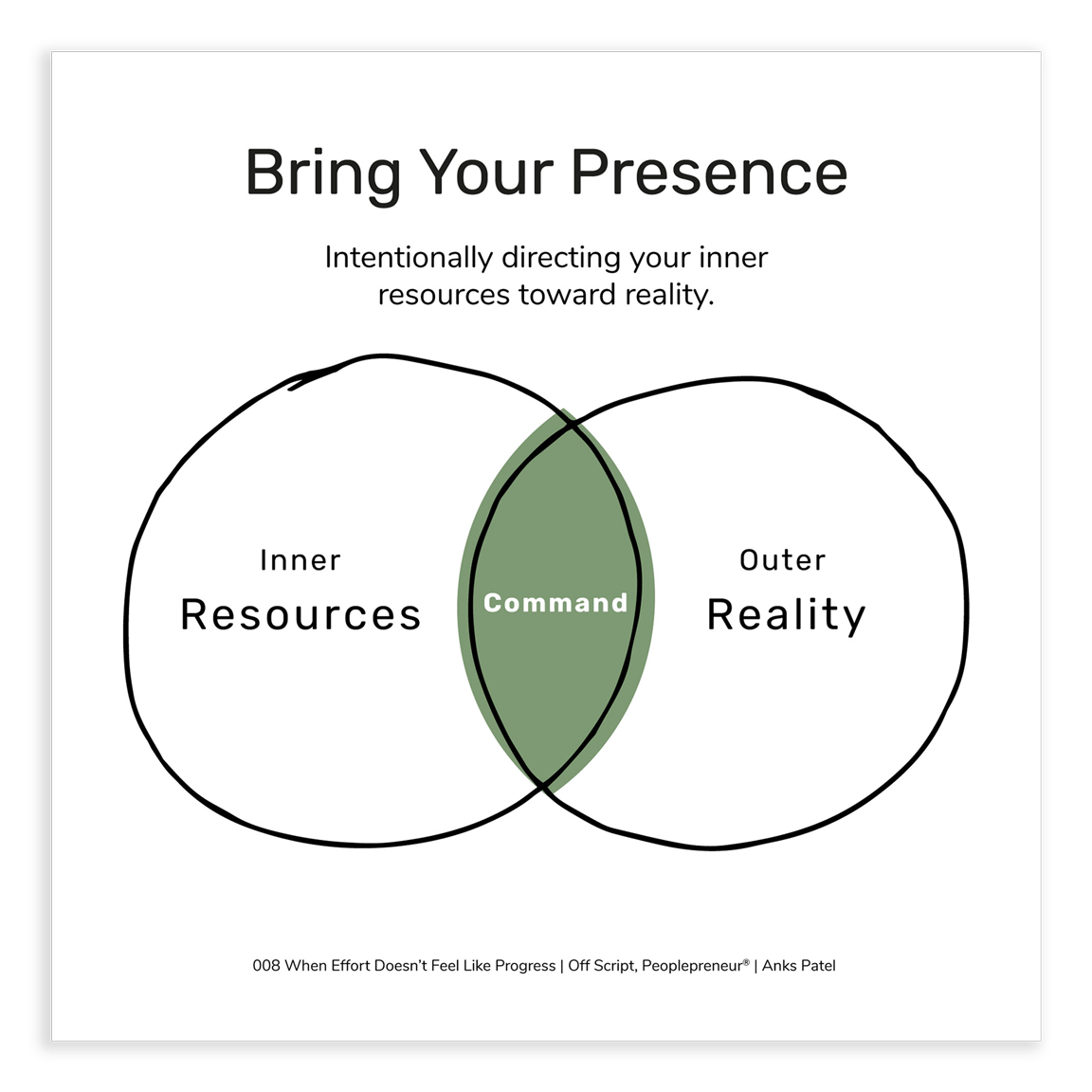
Your focus. Your state. Your emotional command. Your judgement. Your intentions. Your decisions. Your awareness. Your next move. So many others, too many to list here.
It's yours to command.
When nothing seems to be working, the only guarantee you have is your ability to access them. Most people are already using these resources. They’re just directing them the wrong way, removing agency, creating doubt, stopping progress, or creating emotional spirals.
The feeling of being unsure, anxious, worried, none of it removes uncertainty and at no point does life become stable enough to relax our leadership. It's building us into the type of person who doesn't need certainty to move.
All said and done
The advantage you will have isn't knowing what will happen.
It's knowing you can handle whatever does. Meeting experiences by take ownership.
Because the world prefers you to be unsure, because how else would you buy into their promises?
The more self-led you become, the more command you gain over your life.
Until next time, self-leaders.
Anks Patel